Estudio Nuboso

About us

We are an art and ecology platform dedicated to fostering a better relationship between humans and nature, with a focus on the conservation and regeneration of tropical ecosystems in Panama.

Our vision and mission

Our vision is to restore the relationship between humans and nature, as part of the global movement that seeks to create greater harmony and reciprocity with the planet. Our mission is to generate experiences and share knowledge that promote awareness and regenerative practices in individuals, communities and the environment.

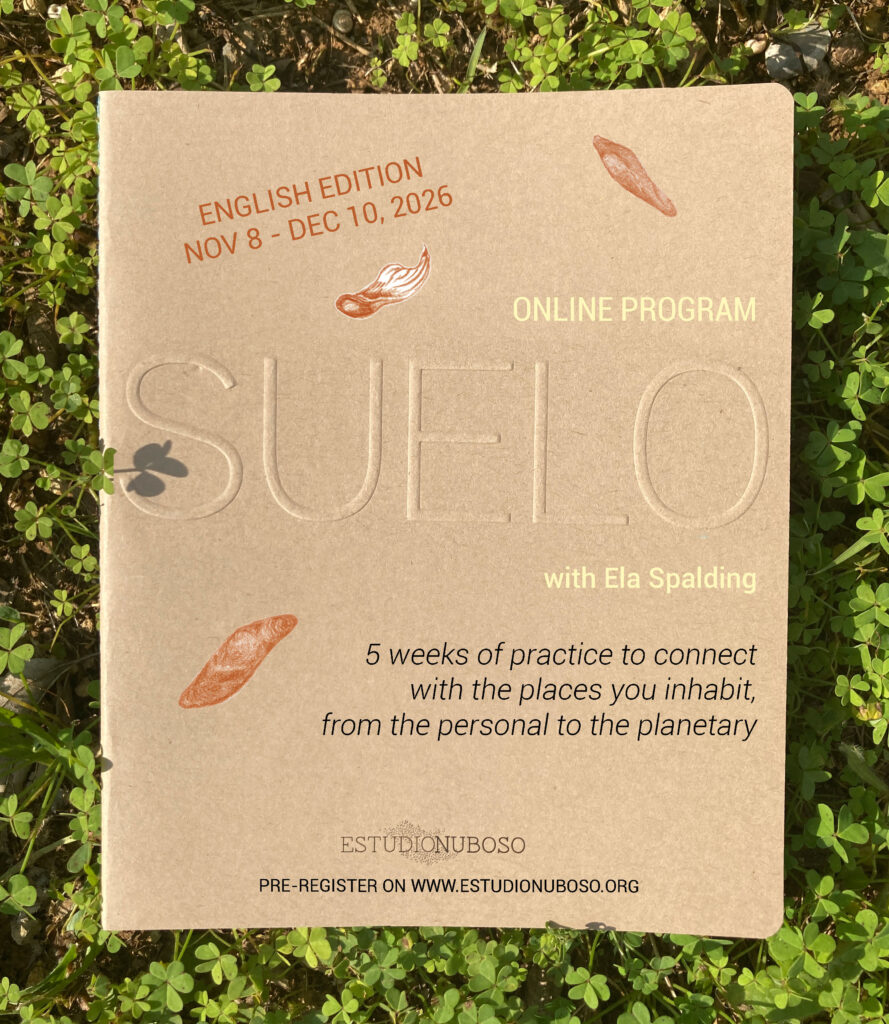
SUELO ONLINE PROGRAM

A space dedicated to practices to connect with place, from the personal to the planetary.

Guided by Ela Spalding, artist~facilitator and author of the SUELO Field Guide.
Format: live + asynchronous. Option in Spanish or English depending on interest.

Dates: November 8 – December 10 in English.

September 20 – October 22 in Spanish. Visit this link.

Time commitment: ~ 3-4 hours per week

Participants: Max. 12 people.

The program is for:

  • any person who resonates with SUELO and wants to connect more with their home – body, surroundings, territory, and planet.
  • facilitators or educators interested in implementing SUELO in their contexts, with their communities, students, or organizations.
  • cultural actors, artists, or institutions, looking for a more ecologically sound connection; more practical, situated, or profound ways to be with the land and their communities.
  • environmental organizations, scientists, or individuals who want to build bridges or deeper connections with the places they inhabit

ABOUT THE PROGRAM

For over ten years and in different geographies —from Panama to Mallorca, I have been developing SUELO: a practice that consists in discovering the deep time, the current ecologies and possible futures of a place, connecting with the land, its stories and its people.

For the first time online, during 5 weeks we will delve into place-based practices and the tools in the SUELO Field Guide. Conceived as a community of practice, each week you will receive an audio visualization that will guide you to an action or reflection in relation with the place that you inhabit, or the place that you want to connect to (you decide).

At the end of the program you will have gone through a series of experiences that will help you to see with fresh eyes, or more clearly, your role in this place. You will have created connections with fellow inhabitants (human or non-human); and will have a series of practices and strategies to articulate the value of the place, and to share this experience with others.

STRUCTURE OF THE 5-WEEK PROGRAM

Every Sunday: you will receive an audio via e-mail with a visualization and exercise.

Sunday to Thursday: you connect with your surroundings in your time, following the impulses received on Sunday.

Thursday: 6pm (Spain time) / 11am or 12md (Panama time, depending on the time of year) – LIVE Zoom with Ela to share with the group and delve into the tools and themes of the week.

Throughout the program: you can exchange with the group through a forum on Substack.

WEEK 1: Introduction to SUELO and to get to know each other.

WEEK 2: SUELO Spheres of (inter)action. Explore our connection to the body and the territory that surrounds us. Define where you want to work and begin your process of mapping/design.

WEEK 3: SUELO Profile. Delve into the layers of place, past, present and possible futures. Connect with the knowledge holders – people and elements of the ecoystem.

WEEK 4: SUELO Associacitions. Different ways of connecting more deeply and to share the experience with your community, colleagues or to a selected audience.

WEEK 5: Presentation of results or processes; celebration, reflection and next steps.

Extra session: after 6 to 10 weeks, we can meet a sixth time to see what has evolved since the program.

WHAT TO BRING?

A blank book, preferably not lined, where you can write down or sketch everything that you experience during the program.

The desire to connect with yourself and your ecosystem through regenerative action.

INVESTMENT

Pay what you can. Accessibility is part of the practice. Please be honest, and select the price that reflects your financial circumstances.

Save your spot

Tejiendo Corredores ~ Weaving Corridors

Bienvenidxs a Tejiendo Corredores ~ Weaving Corridors: Un podcast bilingüe que entreteje voces, historias y prácticas para cultivar corredores natura-cultura de solidaridad planetaria. En conversaciones con artistas, científicos, cuidadores del territorio y organizadores, exploramos cómo conectar el cuidado entre ecosistemas, disciplinas y geografías – desde corredores biológicos literales hasta vías culturales o nuevas formas de apoyo mutuo.

~~~~~~~~~~~~~~~~~~~~~~~~~~~~~~~~~~~~~~~~~~~~~~~~~~~~~~~~~~~

Welcome to Weaving Corridors ~ Tejiendo Corredores: A bilingual podcast that weaves together voices, stories and practices to cultivate nature-culture corridors of planetary solidarity. In conversations with artists, scientists, territorial caretakers and organizers we explore about how to connect care across ecosystems, disciplines and geographies – from literal biological corridors to cultural pathways, or new forms of mutual support.

Alternamos los episodios en inglés y español. Aquí les dejamos un resumen expandido de cada uno en ambos idiomas ~~~ We alternate episodes in Spanish and English. Here we share an extended summary of each one in both languages.

Ep. 1 – Almanaque Azul y su mapa de Corredores – Resumen/Summary

Ep. 2 – Lucia Pietroiusti on the potential role of cultural institutions in an ecological society

Ep. 3 – Fundación Mar Adentro con Maya Errázuriz: arte, ciencia y regeneración

Ep. 4 – Joshua Tewksbury and Ana Spalding: The Importance of the tropics, ocean governance and bridge the nature~culuture gap

Ep. 5 – Agua Salud y Reforestación Inteligente en STRI Panamá, con Jahir Batista

Ep. 6 – Bird Friendly coffee corridors with Melissa Mazurkewicz of STRI Panama.

Este podcast ha sido posible hasta el momento gracias al generoso apoyo semilla de Sylvia Pope y del Instituto Smithsonian de Investigaciones Tropicales en Panamá. Sin embargo, para continuar con la producción, y eventualmente también apoyar a las organizaciones, proyectos y comunidades que presentamos dependemos del apoyo de nuestros oyentes. Puedes subscribirte al Substack de Ela Spalding, hacernos un Yappy (sólo Panamá) o hacer una donación directa a la cuenta corriente de Banco General de la Asociación Estudio Nuboso no. 0338011054250. Escribe a info@nullestudionuboso.org para más información.

This podcast has been made possible thanks to the generous seed funding from Sylvia Pope and the Smithsonian Tropical Research Institute in Panama. However, in order to continue production, and eventually also support the organisations, projects, and communities we feature, we depend on the support of our listeners. You can subscribe to Ela Spalding’s Substack, give us a Yappy (only in Panama), or make a direct donation to the Banco General current account of Asociación Estudio Nuboso no. 0338011054250. Write to info@nullestudionuboso.org for more information.

NATURE-CULTURE CORRIDORS MAP

Click on the map to visit the digital interactive version of the map. And to view a map/directory of existing community-based organisations in Panama, visit this link to the UNDP Panama Small Grants Programme

The Mapa Corredores natura-cultura is a living, participatory map that explores ecological connectivity in Panama. It’s a collaboration between Almanaque Azul and Estudio Nuboso. It highlights key areas of the country where forest preservation is essential to ensure the free movement of species while identifying regions where deforestation has disrupted these flows and where restoration is needed. More than a static cartography, this project invites us to think of the territory as a constantly evolving network, where nature and human action intertwine to restore and protect the country’s ecological corridors.

All living things move: animals, birds, insects, plants and humans. Water, air and the earth itself also move. This movement is essential for life, to feed, reproduce and evolve; it is what allows the diversity of living beings, nature to regenerate and become stronger in the face of change. In this context, ecological connectivity becomes key, as it determines how easy or difficult it is for living beings to move between their living spaces.

Natural corridors are arteries of life that facilitate movement and communication. This map expands Almanaque Azul’s map of natural corridors in Panama by integrating a layer of regenerative human action to explore the idea of nature-culture corridors of planetary solidarity. What it reveals is that there are many, many communities in Panama working together to care for and restore the conditions that enable life on Earth.

We are organized around culture, conservation and territorial defense, restoration or scientific research, in community-based organizations, water boards, collectives and cultural spaces. This visualization illustrates the challenges and also offers hope. It is a reminder that by coming together in collective action we can weave a web of mutual support on a global scale. In an ever-changing world, these connections are needed more than ever.

Version 1.0 MAC – February 2025

This map is based on Almanaque Azul’s Map of Panama’s natural corridors, whose research, production and dissemination was carried out by Miriam Pons, Mir Rodríguez Lombardo, Michelle Szejner and Jessica Wakauma Ausinheiler. With original layout by Marilaura Cajar Benavides.

Thanks to the support of Rossie Pope-Meyer, president of the board of directors of Pro Eco Azuero, and Sylvia Pope.

Cartography: Mir Rodríguez Lombardo.

Adaptation for canvas mounting for Estudio Nuboso’s 10+ years expo: Dominique Ratton Perez and Ela Spalding

Data sources: Ministry of Environment (land use map 2022, SINAP, OBCs), Tommy Guardia National Geographic Institute (road network, borders, coastline, rivers, provinces and districts), Kendra Walker (2019, vegetation), OpenStreetMap contributors (road network, coastline), National Institute of Statistics and Census, Comptroller General of the Republic of Panama (villages and human population density with 2010 census data), Carolina Borrero Arias with initiatives documented in her film La Selva Llama, Panama Museum and Visitor Center Network, Ministry of Health (JAARs), National System of Conservation Areas (Costa Rica), National Natural Parks of Colombia.

Includes data from the project “Strengthening the capacities of Community Based Organizations at the national level”, financed by the PPD-UNDP/GEF Small Grants Program.

Experts consulted: Alicia Ibañez, Beatriz Schmitt, Charlotte Elton, Daniel Holness, Jonathan González Quiel, José Manuel Mendieta, José de Jesús Vargas González, Melisa Ayala, Néstor Espejo, Pedro Méndez-Carvajal, Ricardo Moreno, Roney Samaniego and Samuel Valdés.

www.almanaqueazul.org / www.estudionuboso.org

Contact

For any questions you can write us at info@nullestudionuboso.org or follow us on our social media: Instagram and YouTube.

We are a non-profit association registered in Panama since 2012 and are members of the Green Art Lab Alliance. If you like what we do and want to support us in our growth and outreach, don’t hesitate to contact us!